Dementia Caregiving Statistics 2026: The Numbers Behind the Overwhelm
If you’re caring for a parent with dementia and feeling like you’re the only one drowning, these numbers say otherwise. This page aggregates the most-cited 2026 dementia and caregiving statistics from leading aging and health organizations, with a source link on every line — for journalists, students, and the families living it.
Updated regularly to reflect the latest reporting. Last reviewed: June 2026.
On this page: Prevalence · Who provides care · Financial impact · The caregiver toll · Time burden
An informational roundup, not medical advice. These are population statistics, not a prediction about any one person.
Prevalence in the United States
Dementia is common and growing as the population ages — which is exactly why so many families are pulled into caregiving at once.
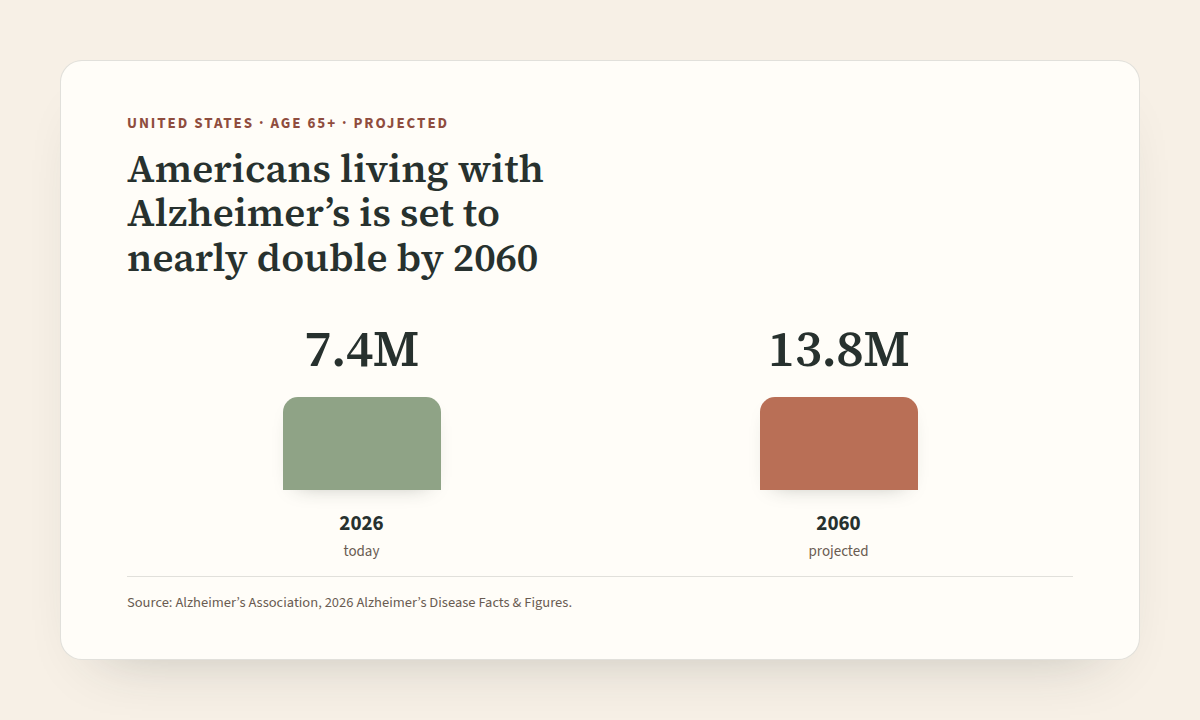
- An estimated 7.4 million Americans age 65+ are living with Alzheimer’s in 2026. — Alzheimer’s Association
- About 1 in 9 people age 65+ (≈11%) has Alzheimer’s dementia. — Alzheimer’s Association
- 74% of those living with Alzheimer’s are age 75 or older. — Alzheimer’s Association
- The number is projected to reach 13.8 million by 2060. — Alzheimer’s Association
Who provides the care
The vast majority of dementia care is unpaid and provided by family — most often adult children and spouses, frequently while holding down jobs of their own.
- There are roughly 13 million caregivers of people with Alzheimer’s or other dementias. — Alzheimer’s Association
- Women make up nearly two-thirds of dementia caregivers. — Alzheimer’s Association
- About 30% of dementia caregivers are themselves age 65 or older. — Alzheimer’s Association · CDC
- About 29% of family caregivers are also raising children while caring for an aging parent — the “sandwich” generation. — AARP/NAC, Caregiving in the U.S. 2025
The financial impact
Dementia is one of the most expensive conditions to live with, and families absorb much of the cost directly.
- Total health and long-term care costs for people with Alzheimer’s and other dementias are projected at $409 billion in 2026 (excluding unpaid care). — Alzheimer’s Association
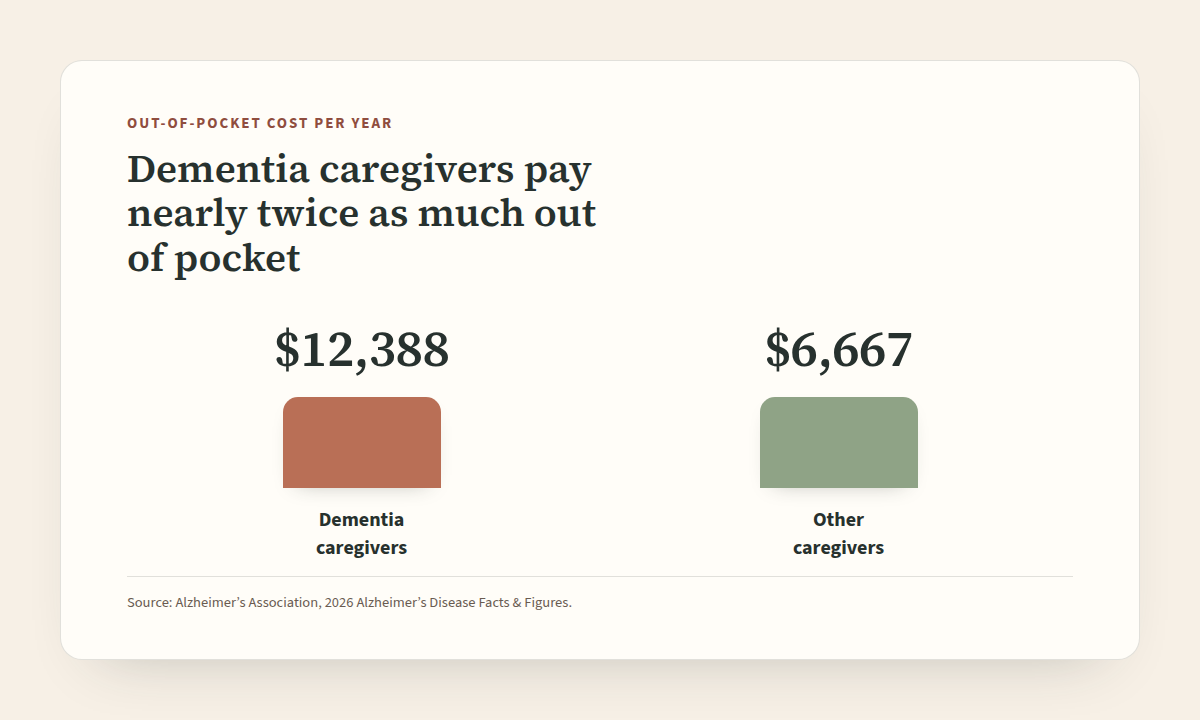
- Dementia caregivers bear nearly twice the out-of-pocket costs of non-dementia caregivers — $12,388 vs. $6,667. — Alzheimer’s Association
- The lifetime cost of caring for a person with Alzheimer’s is estimated at $405,262 per person (2024 dollars), with about 70% borne by families through unpaid care and out-of-pocket costs. — Alzheimer’s Association
The toll on caregivers
Caregiving exacts a real cost in health, work, and well-being.
- 59% of dementia caregivers report high to very high emotional stress, and a substantial share report physical strain. — Alzheimer’s Association
- Many caregivers report reducing work hours, taking leave, or leaving a job because of caregiving demands. — AARP/NAC, Caregiving in the U.S. 2025
- Caregiver burnout is common and frequently underreported. — Family Caregiver Alliance
The time burden
Care adds up to a second full-time job’s worth of hours across the country.
- In 2025, unpaid caregivers provided 19.6 billion hours of care to people with dementia — valued at $446.3 billion. — Alzheimer’s Association
- Dementia caregivers provide an average of nearly 31 hours of unpaid care per week — more than caregivers for most other conditions. — Alzheimer’s Association
A note on these numbers
Statistics describe populations, not your parent. If you’re using this page to get oriented, the most useful next step isn’t another number — it’s a first step. Start here: My Parent Was Just Diagnosed. What Do I Do First?
Compiled by Care90 Editorial. Figures are aggregated from public reports by the Alzheimer’s Association, CDC, AARP/NAC, and the Family Caregiver Alliance; follow each link for the original source. Found an out-of-date number? Tell us and we’ll fix it.